There’s a reason they call Sedona, Arizona the most beautiful spot in the United States.
Regardless of how you approach the city, there is beauty all around you.
Whether you’re looking for an outdoor adventure or a little culture, you’ll find it here:
Biking In Sedona
If you’re driving to the area make sure you bring your bike. Sedona has numerous bike trails, and they’re growing each year. The newest trails are along the Red Rock Scenic Byway.
If you do forget your bike, not to worry, there are plenty of places to rent one.
When you’re ready to put the miles in, make sure you plan your trip in October to enjoy the Sedona Century Bike Tour. It is forty miles of scenic beauty through rivers, desert views, and red rocks.
Horseback Riding
If sitting on a bike all day isn’t your thing, perhaps seeing the countryside on horseback might be more to your liking.
Get ready to play cowboy or cowgirl as you wind your way through Red Rock Country crossing creeks and dining under the stars.
Hot Air Ballooning over Sedona
For a wider view, consider a hot air balloon ride over the canyons and ancient ruins.
An aerial view let’s you truly appreciate the scope and size of the area. There’s nothing more beautiful than watching the sun rise over the canyons from 1,000 feet in the air.
Golf or Tennis?
Once back on firm ground, consider an afternoon of golf or tennis. There are several championship courses open to the general public.
The Sedona Golf Resort, surrounded by red rock formations, is just one of the stunning courses available. If you would rather not spend all day on the course, there are also executive courses for a quick nine holes.
Sedona is a perfect location for the tennis lover.
Visitors can play year round at many of the local resorts.
The weather is always just right for tennis, and professional instruction and competition is available for those who need a little brushing up on the game or are ready to take on a challenge.
Sedona Indoors
If you’re eager to spend a little time indoors, Sedona has you covered.
The city is home to film festivals, theatres, music, and over eighty art galleries.
You’ll find festivals throughout the year, so do make sure you check out what’s happening during your stay.
You’ll also find local wineries to explore and indulge your taste buds after a day in the canyons. Restaurants run the gambit with a little something for everyone whether you are looking for fine dining or an al fresco experience.
The Red Rock Canyon isn’t the only thing to feast your eyes on in Sedona.
Going Cuckoo
Due to its elevation and climate, Sedona is a bird lover’s paradise.
In the month of May, more than a hundred and thirty different species of birds are normally seen during one bird watching outing in the Verde Valley.
During the last week of April, the yearly Verde Valley Birding and Nature Festival is held in nearby Cottonwood, Arizona.
Weddings
Sedona is also a wonderful location for that special day.
When you’re looking for an outdoor wedding, the beauty of Sedona can’t be matched.
Professional wedding planners are on hand to help you will all the details necessary to make your special day a day you’ll never forget. After the ceremony, consider riding off into the sunset on horseback or in a horse-drawn carriage.
Regardless of your interests, you’ll find what you’re looking for in Sedona. From a Wild West adventure to relaxing on the veranda, there is truly something for everyone. Coming to Sedona is easy. It’s the leaving that’s the hard part.
Own Land in Arizona: The Ultimate Off-Grid Adventure Awaits You on 1.25 Acres of Land in Holbrook, Navajo County, Arizona Get it Click Here
There are physical adventures, there are mental adventures, and then there is ayahuasca: a relentless spiritual-physical-mental adventure that may be one of the most intense ordeals your soul can choose to experience in this life.
If an ayahuasca ceremony is on your bucket list, you no longer have to go all the way to South America’s Amazon to reach your goal.
Thanks to religious freedoms in the USA, you can finally check-off this list item, the ayahuasca ceremony, without leaving the USA. There are a handful of legal ceremonies popping up in urban areas and far-out locations in scattered pockets across the United States of America.
According to our new section, the ayahuasca retreat directory, a Native American Church is offering ayahuasca in the United States for people interested in the sacramental ritual of an ayahuasca ceremony and the full-on spiritual practice of ayahuasca tea imbibing.
“The tea, known as Ayahuasca, is revered as sacred by Church members. It is a sacrament serving to heighten spiritual understanding and perception, and brings the practitioners closer to God and the Divine.” — Chief Minister Steve Hupp
It seems that the religious protections invoked by the religious freedom in America have made it possible — for people acting under the auspices of a church — to recruit new members to the church’s spiritual practices, where, as a potential member, you can partake in the ritual drinking of ayahuasca.
In other ceremonies that take place in the USA, invoking religious freedoms, take the UDV, for example, where it’s typical for UDV ayahuasca sessions to include dancing all night, wearing pure white clothes, and singing Christian songs. That’s right, the UDV is Christian. During a ceremony you’ll be immersed in an alternative Christian world that — to outsiders, the uninitiated, fundamentalist, or bible pounding puritans — may seem like sacrilege.
For the Native American church in Kentucky, you’ll have contact them to find out exactly what their ceremonies entail.
This is the most unusual US ayahuasca experience to come across Heroic Adventures’ radar, and it happens to be located in the same state as one of North America’s most famous horse races, the Kentucky Derby.
Yes, you read that correctly, Kentucky.
Save the South American journey. Instead, buy your plane ticket to Kentucky.
In all fairness, probably not everyone is as excited about an ayahuasca adventure in Kentucky as they would be taking the sacred medicine, say, with a Shipibo medicine man in South America — but, the novelty of the offer can’t be disputed.
Imagine it, you can fly from New York City down to Kentucky in a weekend. After drinking ayahuasca and having a lifetime’s worth of spiritual bombardment entering your consciousness, you’ll be a new person when you go back to the office in New York on Monday.
It’s time to take a Heroic Adventure not to the Amazon but to Kentucky.
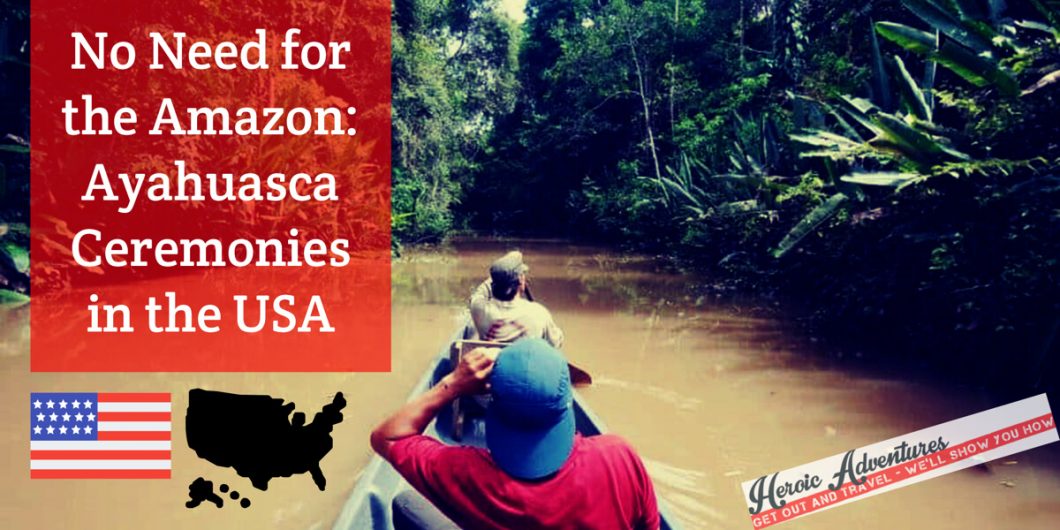
Compare the first photo from the Amazon, below, to the second photo of Kentucky, below, it would appear there is a spiritual connection between the two… Well, at least, they both have a lot of nice green plants.
The Amazon isn’t the only place to legally ingest ayahuasca. Ceremonies are now emerging commercially in the United States of America.
Looking a bit like the Amazon without the river, in Kentucky you can now legally drink ayahuasca with a Minister from a Native American Church.
And, a caveat from a reader:
“Hey Team,
I’m not one to normally send feedback on posts, but this feels especially warranted. I appreciate you giving information to the public about Ayahuasca ceremonies being held in the U.S. I believe it’s a positive move forward that Americans will have Ayahuasca as a more accessible possibility. However, as someone who has experienced Ayahuasca, I really advise against saying things like “Imagine it, you can fly from New York City down to Kentucky in a weekend. After drinking ayahuasca and having a lifetime’s worth of spiritual bombardment entering your consciousness, you’ll be a new person when you go back to the office in New York on Monday.” That’s a very, very scary thing to advise people to do. When you take the medicine, it stays in your system for a much longer period than the one or two days you’ve actually consumed it. You need to have preparations in place for how you’re going to reintegrate into your daily life after the experience, and making it sound like it’s a “no big deal, let’s go do Ayahuasca this weekend” kind of thing is not only dangerous but it’s furthermore disrespectful toward and completely underestimating the power of the medicine.
I’m not trying to be a heckler, but please understand that this is powerful stuff. For the sake of your readers, I hope you reconsider the phrasing of your post and add in how important it is to seriously consider whether they’re ready to take the medicine, as well as how important it is for them to do their research regarding preparations before and after the experience.
Thanks for your time, Lori”
(updated August 26, 2015)
Interesting Discussion on Legality of Ayahuasca in the USA
In the Fall of 2015, a website popped up touting the First Ayahuasca Church in the USA that is open for ceremonies to anyone. Now this is a distinct organization front Mr Hupp (in the article above). After this article was published detailing why this church is not legal–it seems the site went offline, maybe it will emerge again–for your own investigations–here is the link: https://ayahuascahealings.com.
And to see the site in it’s original splendor, the Internet Archive has a stash of how the site last looked on November 20th, 2015, available here: Ayahuasca Healing Internet Archive Snapshot
A curious story in the world of spirituality, religious rights, internet marketing, and law.
To a viewer unfamiliar with mahjong, the game and how to play it can present a bewildering spectacle, what with its walls of tiles, talk of prevailing winds and the constant clatter of pieces being discarded in turn by the four opposing players.
This quintessentially Chinese game is, in fact, very similar to a number of Western card games such as rummy. The goal in mahjong is to complete a set with your tiles similar to a poker or rummy hand.
Anyone used to card games where a winning hand consists of a straight flush or a full house can easily get their head around the basic rules of mahjong.
Mahjong: The Tiles
The most distinctive pieces in a mahjong set are undoubtedly the tiles.
Based originally on paper cards, the tiles are now solid, chunky pieces with an image or character on one side (similar in a sense to a domino) and a thick backing of bamboo or, more usually these days, plastic on the other.
There are three categories of tiles:
simples
honors
bonus
As is the case with a set of playing cards, the simples fall into suits.
In mahjong there are three suits for simples:
bamboos
characters
circles
Each suit consists of nine tiles numbered one through nine. There are four copies of each of these tile in a set.
The honor tiles are divided between dragons (red, green and white) and winds (east, south, west and north) while the optional bonus tiles (flowers and seasons) are used mainly for the purposes of scoring and gambling.
Mahjong: The Dice
A mahjong set will also include a number of dice with which players determine who is to deal and where the dealing is to begin and a marker to show who is dealing and which round is being played.
Some sets may also include countersto help with scoring and racks into which players may place their tiles so they remain hidden from the other players.
Mahjong: Standard Game
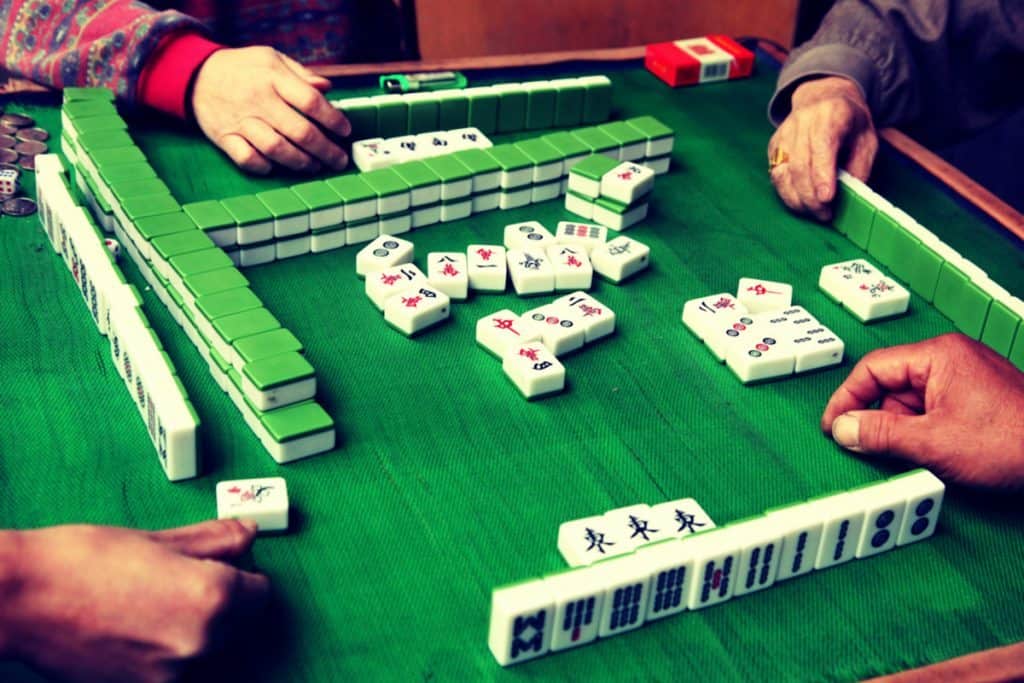
A standard game begins with the players choosing a dealer either by means of a high-scoring roll of the dice or by the blind drawing of wind tiles (featured in image below).
The dealer is assigned the position of East wind and play proceeds in a counter-clockwise motion to the other players, each of whom is assigned the wind respective to their position in regard to the dealer.
When a round is finished, the position of dealer shifts to the player on the dealer’s right.
Once a dealer has been chosen and the tiles have been shuffled, each player takes thirty-six tiles and builds a wall in front of them two tiles high and eighteen tiles wide, see image below for what this looks like:
The players then push their walls together forming a square, the hollow center of which will be used for discarding tiles.
The dealer then rolls three dice and, counting along the row of tiles to his or her right, begins dealing from the tile which corresponds to the sum of the dice.
One by one, over three rounds, the players take four tiles at a time and one last tile for a total of thirteen tiles each.
Game play proper begins with the dealer taking an extra tile and then discarding a tile of his or her choice.
A winning hand in mahjong consists of fourteen tiles.
Except when drawing a tile during a turn, however, a player should only ever have thirteen tiles in their possession.
The aim is to have your hand divided neatly between a number of groupings.
In mahjong these groupings consist of:
Lungs – three of a kind
Kongs – four of a kind
Chows – a run of three consecutive tiles of the same same suit
‘A pair’ – used to round out a winning hand
During a round, a player draws a tile from the wall.
If the tile cannot be used to complete a set the player then discards it.
When another player can use the tile to complete a set, that player is allowed to claim it and take the next turn.
Otherwise, following a discard, play continues in a counter-clockwise motion until someone has completed a hand.
In Western games a winning hand is often referred to as a “mahjong” and the player will call it as such when he or she has drawn the winning tile.
Mahjong: It’s Easier than You Think
It is the unusual set-up of the game which often seems so daunting to the novice player of mahjong. But once a player is used to the assigning of winds, the building of walls and the dealing of tiles, mahjong is actually quite straightforward.
Games can, of course, get rather complicated once you begin to grasp the possible strategies involved.
Systems of scoring too can render the game overly complex, but a player can always just adopt the simple option of scoring winning hands only.
Ultimately mahjong can be as simple or complex as you wish to make it and this is perhaps the secret of its enduring success.
For those of you taking Heroic Adventures to your local China town or further wanderings to parts of Asia, knowing how to play mahjong can be a way to make a healthy connection with locals and gain deep insight into local culture.
How to Play Mahjong: The Top Books for Beginners
American Mahjong Set, Panda Tiles with Tawny Brown Fabric Case
Tokyo is one of the world's largest and most vibrant cities. The Japanese capital has something to offer visitors in all seasons. Japan's rich history and unique popular culture attracts tourists year round.
Depending on the season, a trip to Tokyo is sure to coincide with events or festivals both old and new, ranging from centuries-old ceremonies to modern Japanese takes on western-influenced festivals such as Christmas and Halloween.
Whenever you're planning to visit, this guide to Tokyo's best monthly events should help you add some unique flavor and culture to your trip.
January features what the Japanese refer to as Golden Week.
During Golden Week, Tokyo’s famously intense work culture grinds to a halt to celebrate New Year. Japan celebrates New Year on December 31, rather than celebrating the Lunar New Year later in January or February like China and South Korea.
Tokyo’s busy streets feel relatively deserted during Golden Week, as many office workers return to their hometowns to spend the festival with their families.
There is still plenty to keep tourists busy, however, with nightlife districts Shibuya, Shinjuku and Roppongi offering tons of bars and clubs with booming countdown parties on December 31. You could also join the crowds counting down to the New Year in Shibuya’s Central Gai street.
For a more traditional New Year experience, head to a Buddhist temple to hear 108 bells ring in the New Year. The temples ring their bells 108 times to symbolize the 108 Earthly desires Buddhists consider responsible for leading humans astray.
The most popular bell ringing ceremonies take place at Zojoji Temple near Tokyo Tower and Sensoji Temple in Asakusa.
January also features the first of three sumo wrestling seasons at Tokyo’s Ryogoku Kokugikan.
From January 8 to 22, fights begin with rookies early each morning and climax with championship fighters in the afternoon.
Cheap tickets are available for about 2000 Yen. These tickets sell out fast, so a good tip is to buy your ticket at Ryogoku Kokugikan at 8 a.m., then spend the rest of the morning exploring Tokyo, before returning late in the afternoon to watch the main event fights.
February
February marks the official transition from winter to spring, with Buddhist temples holding the Setsubun event on February 3 to celebrate.
The prime spots in Tokyo are again Zozoji Temple near Tokyo Tower and Sensoji Temple in Asakusa, where celebrities throw beans to crowds decked in traditional Japanese kimonos.
Japan has unique takes on many Western holidays, with Valentine’s Day on February 14 being no exception. Expect to see huge displays in stores promoting Valentine’s gifts.
The biggest difference between Valentine’s Day in Japan and the West is that women are expected to shower their boyfriends with chocolate-based gifts on Valentine’s Day, with the men returning the favor a month later on White Day.
March
The transition from winter to spring reaches its climax in March, with Tokyo’s residents flocking to the city’s many parks to see the beautiful and short-lived cherry blossom.
Trees across Tokyo sprout deep-pink leaves which fall away within weeks. Cherry blossom festivals celebrate this transition. The best place to enjoy the scenery are the gardens surrounding the Imperial Palace and at Shinjuku Gyoen, while the liveliest flower viewing Hanami parties can be found in Ueno and Yoyogi park.
Another unique Japanese festival is Doll’s Day on March 3, which celebrates young girls transition into womanhood.
Most Japanese mark Doll’s Day with small family gatherings, but there are some special events to mark the occasion that can add local flavor to a Tokyo trip.
Chiba, which lies to the east of Tokyo and is part of the capital’s sprawling subway network, hosts an huge display of dolls on the steps of Tomisaki Shrine.
April
The cherry blossom festivals continue well into April, so visitors can still enjoy the view at Tokyo’s many parks.
April also features perhaps the Tokyo metropolitan region’s most bizarre festival: Kawasaki’s Festival of the Steel Phallus.
The Festival of the Steel Phallus commemorates a legendary sharp-toothed demon which resided in women’s nether regions and devoured male appendages.
This risqué legend has today transformed into a festival which raises awareness and funds for the fight against HIV and other sexually transmitted infections. Crowds flock to Kawasaki’s Kanayama Shrine for a bizarre event featuring a wide array of phallic party pieces.
May
May’s Mikoshi festival at Asakusa’s Sensoji temple is a unique event in which teams from across Japan compete in wild synchronized displays.
The teams throw huge mikoshi statues in the air as they run around the temple in elaborate displays. This high-energy festival begins on the third Sunday in May and lasts for three days, with up to two million tourists visiting Sensoji temple to watch the action.
May also gives visitors to Tokyo their second chance at watching sumo wrestling at Ryogoku Kokugikan.
June
June sees spring transition to summer with Japan’s rainy season.
June isn’t an ideal time to visit Tokyo, as two-thirds of days are typically subject to heavy rainfall. The bad weather doesn’t mean a trip to Tokyo in June is a complete washout though.
Between June 7 and 17, visitors to Tokyo can experience the traditional Sanno festival.
The Sanno festival is a quieter and more somber affair than most Japanese festivals, but it is nevertheless an immense spectacle.
The highlight is a nine-hour parade through Tokyo’s busiest streets, beginning and ending at Hie Shrine in Chiyoda.
Huge crowds gather in Chiyoda to witness the Japanese emperor visiting the temple at the parade’s 5 p.m. climax.
A good spot to watch the parade’s progress is the garden in front of the Imperial Palace, which the procession typically passes at midday.
July
Like June, much of July falls in the rainy season, though this gives way to sweltering summertime by the end of the month.
From mid-July onwards, visitors flock to Japan’s beaches.
This is a perfect time to visit Kamakura, situated to the south of Tokyo and connected to the capital’s subway network. Kamakura combines some of Japan’s most beautiful and historic Buddhist temples with long stretches of beach, making it a perfect short trip for visitors to Tokyo.
Japan’s best beaches are on the Pacific island of Okinawa.
While Okinawa is a four-hour flight from Tokyo, the island’s culture comes to the capital with late July’s Eisa festival in Shinjuku. This vibrant summer festival features Okinawan dancers showcasing a local culture which is a unique blend of Japanese and Pacific island traditions.
Asakusa is a must-see at any time of year, but late July may be the best time of year to visit Tokyo’s historic temple district, as the month ends with a huge fireworks display. The Sumidagawa fireworks display usually falls on the same day as the Shinjuku Eisa festival, giving energetic visitors an action-packed day.
August
August is sweltering hot, with the end of the rainy season bringing temperatures above 35°C/95°C.
August is the height of summer and peak tourist season, with both overseas visitors and Japanese tourists flocking to all Japan’s main travel destinations. August is also peak festival season, with a diverse selection of events taking place across the capital.
Yosakoi is an energetic modern take on traditional Japanese dance.
Teams from across Japan gather in Tokyo’s hip Harajuku and Omotesando districts in late August for Tokyo’s largest Yosakoi festival. The elaborate routines are a must-see for anyone visiting Tokyo in August.
Early August brings two major fireworks festivals to the Tokyo metropolitan area.
Edogawa Hanabi sees Tokyo compete with neighboring Chiba with dueling fireworks displays on opposite banks of the Edogawa river.
An even larger display takes place at the Kanagawa Shinbun festival in the picturesque Minato Mirai area of Yokohama, which is easily accessible via the Tokyo subway network. Kanagawa Shinbun is Japan’s largest fireworks festival, attracting around one million visitors each year.
September
September is one of the best months to visit Tokyo, as the weather is hot without being as oppressively humid as August.
Tourists who missed August’s peak festival season should visit the Fukuro Matsuri festival in Ikebukuro in late September.
Fukuro Matsuri could be considered a ‘best of’ or ‘taster’ version of the August festivals, as it features synchronized mikoshi displays and a wide variety of traditional and modern dance competitions.
Japan is the spiritual home of video gaming, so gamers visiting in mid-September will want to check out the Tokyo Game Show.
The biggest companies in the video game industry converge in Tokyo for a huge conference where they show off many of the new titles that will be released in the year ahead.
The good weather also makes September a perfect time for video game fans to go Mario Karting on Tokyo’s streets.
This wacky activity lets visitors dress up as Mario Kart characters and ride go-karts through Tokyo’s busiest streets.
Although real-life Mario Karting is possible all-year round, combining it with the Tokyo Game Show makes September the perfect time to make a gamer’s pilgrimage to the Japanese capital.
September is your third and final chance to catch sumo wrestling at Tokyo’s famous Ryogoku Kokugikan.
October
Japan has embraced several Western holidays, none more so than Halloween.
Japan’s affinity with cosplay reaches its apex on October 31, with huge crowds gathering to party on the streets of Shibuya. There are also family-friendly parades throughout the Tokyo metropolitan area, with the biggest taking place in Kawasaki.
Halloween is also the perfect time to visit Tokyo Disney Land, with visitors flocking to its Halloween parade. Tourists who would rather avoid the crowds and visit Disney Land at a less busy time should definitely keep away during Halloween weekend though!
Two major conventions typically take place in October.
The Tokyo Motor Show is held once every two years and attracts huge numbers of car lovers with the world’s latest automobile innovations.
Tokyo’s neighboring city Chiba hosts CEATEC each year, which is Japan’s largest consumer electronics show. CEATEC is the best place to check out Japan’s latest technological innovations, including cutting-edge robotics.
Finally, October provides the yang to the ying of the spring’s cherry blossom festivals, with huge crowds flocking to Tokyo’s parks to see the leaves’ autumnal color change.
As with the cherry blossom festivals, the best places for leaf viewing are the parks at the Imperial Palace, Shinjuku Gyoen, Ueno and Yoyogi.
November
The fall leaf viewing season continues throughout November, so visitors to Tokyo should visit one of the city’s main parks.
Icho Namiki Avenue is another popular place for leaf viewing. This long street runs between the upmarket areas of Gaienmae and Aoyama Ichome and is lined with ginko trees, the leaves of which are particularly striking in the fall.
Tokyo’s Design Festa takes place in early November. This event features 10,000 artists of all stripes, from painters to musicians. Design Festa runs for three days and offers a perfect chance to sample Japan’s unique and diverse arts scenes.
A more traditional festival takes place in early November at the Meiji Shrine beside Yoyogi park and Harajuku.
Traditional activities such as archery and sumo wrestling are showcased at this three-day event that provides visitors with a taste of Japan’s rich cultural history.
December
Christmas is another Western festival which has been embraced in Japan, with many parks and businesses throughout the city adorned with Christmas lights throughout December.
Elaborate Christmas lights can be found throughout the city, but the displays at the Tokyo Dome, Tokyo Midtown and Yebisu garden place are among the most popular.
Visitors to Tokyo can also catch a rare glimpse of the Emperor in December.
December 23 is the Emperor’s birthday, which is a public holiday throughout Japan. The Emperor marks the occasion by addressing crowds at the Imperial Palace.
Tokyo is a huge city with much to offer visitors at any time of year. Whenever you visit, there are sure to be unique events which can make a visit to Tokyo an unforgettable experience.
Suvarnabhumi International Airport and Don Mueang International Airport (sometimes Don Muang) are two separate airfields serving Bangkok.
The site of harried tourists leaving their hotels and arriving at the wrong airport has become more common as flight traffic increases in Bangkok.
Tourists should be prepared and know which airport they will be using, how to get there, the differences between the two and the services available at both.
In September, 2006, a Qantas flight bound for Sydney departed Don Mueang Airport at 3:12 a.m.
It was to be the final commercial flight from the field that had served Bangkok since 1914. Operations ceased and were transferred to Bangkok’s new airfield, Suvarnabhumi International Airport.
The closure was short-lived, however: Operating costs at Suvarnabhumi Airport were high, and safety concerns over cracked runways and taxiways created a crisis of confidence.
Low-cost carriers saw Don Mueang Airport as a viable transit hub, and authorities began to see it as a reasonable alternative to expanding operations at Suvarnabhumi International.
By March 2007, Don Mueang International Airport again reopened for domestic flights.
Today, legacy carriers and long-haul international flights operate from Suvarnabhumi International, while low-cost carriers operate from Don Mueang International.
Here are some things to know about Bangkok’s Two Airports:
Suvarnabhumi International Airport (BKK)
Suvarnabhumi International Airport, 25 km east of the city, is the sixth-busiest airport in Asia and handles 53 million passengers yearly. It also has the world’s tallest free-standing control tower. It serves as the main hub for Bangkok Airways, Orient Thai, and Thai Airways. It was built in an area formerly known as Nong Nguhao, or Cobra Swamp.
The terminal is massive and as beautiful as it is functional.
TIP: Tourists should be warned that the arrivals hall can be populated by con-men and illegal taxi drivers, and should use care.
Getting to and from Suvarnabhumi is easy
In addition to taxis and express buses, the Airport Rail Link, which operates from 6 a.m. to midnight, connects Suvarnabhumi to downtown Bangkok.
Connections to Bangkok’s MRT subway system can be made at the Makkasan City interchange, while the BTS Skytrain connects at the end of the line, at Phayathai Station.
Transit is cheap and the connections are easily made, but parties of three or more may find it cheaper to take a taxi.
Video Guide to Suvarnabhumi International Airport (BKK)
Don Mueang International Airport (DMK)
Don Mueang International Airport, 25 km north of the city, has seen yearly double-digit growth in passenger travel and handled over 35 million passengers in 2016.
Don Mueang International Airport began handling commercial traffic in 1924 and served as a major US base of operations during the Vietnam war.
Most people traveling between Bangkok and Don Mueang Airport opt for a taxi, as there are no fast transit options in and out of the city.
A few bus routes travel to Don Mueang.
Some travelers attempt to take the Skytrain to Mo Chit station, and taxi from there, but savings are slim and reports of difficulties finding cabs at Mo Chit abound.
Travel Time from Don Mueang Airport to Bangkok CBD
Approximate time into Bangkok is 45 minutes or more.
Video Guide to Don Mueang International Airport (DMK)
Airport confusion can be prevented in Bangkok.
First, tourists must note well which airport serves their airline.
Second, you must be specific with cab drivers when traveling from hotels to the airport. It is prudent to have the name and the address written along with the terminal number to avoid confusion.
Bangkok’s two airports each serve different but equally important purposes.
Knowledge of the two and prior planning can save a mad dash between Suvarnabhumi International Airport and Don Mueang International Airport as minutes tick down to departure.
Happy trails… now catch your flight!
Bangkok Airports FAQs
How far are Bangkok Airports from each other?
The two airports DMK and BKK are 29.5 miles apart. That is 47.5 kilometers (KM).
How far is DMK from BKK?
The two airports DMK and BKK are 29.5 miles apart. That is 47.5 kilometers (KM).
Which Bangkok Airport is closest to the city center, CBD?
Don Mueang International Airport (DMK) is closest to Bangkok city center.
BUT, Suvarnabhumi International Airport (BKK) is better connected to the city center transport-wise via the Airport Rail Link. Your only options of transport at DMK is via a vehicle, either a bus, taxi or other potentially traffic jammed transport.
How many airports does Bangkok have?
Two, Don Mueang International Airport (DMK) and Suvarnabhumi International Airport (BKK).